
When it comes to maritime commerce and international trade, the United States runs on its ports. This vast network of harbours acts as the country’s gateways to the world, moving everything from cars and electronics to grain, crude oil and consumer goods. But which are the biggest ports in the US, and how do we measure “biggest” in the first place?
Most rankings of the largest ports in America are based on container volume, counted in TEUs (twenty-foot equivalent units — the standard shipping container).
By that measure, the Port of Los Angeles is the largest port in the US, and has been for years. It’s worth knowing, though, that “largest” can mean different things: by total cargo tonnage, Gulf Coast energy ports such as Houston and South Louisiana lead the nation, while by container throughput the West Coast dominates.
In this guide we rank the country’s major ports by 2024 container volume, then explain what makes each one matter.
Here’s a closer look at the 11 largest ports in the United States you should know about.
US ports at a glance (2026 container volume)
| Rank | Port | 2024 Volume (TEUs) | Coast |
|---|---|---|---|
| 1 | Port of Los Angeles | ~10.3 million | West |
| 2 | Port of Long Beach | ~9.65 million | West |
| 3 | Port of New York & New Jersey | ~8.70 million | East |
| 4 | Port of Savannah | ~5.55 million | East |
| 5 | Port Houston | ~4.1 million | Gulf |
| 6 | Port of Virginia | ~3.50 million | East |
| 7–8 | Seattle & Tacoma (Northwest Seaport Alliance) | ~3.34 million combined | West |
| 9 | Port of Charleston | ~2.50 million | East |
| 10 | Port of Oakland | ~2.26 million | West |
| 11 | Port of New Orleans | Leading Gulf bulk & breakbulk port | Gulf |
1. Port of Los Angeles
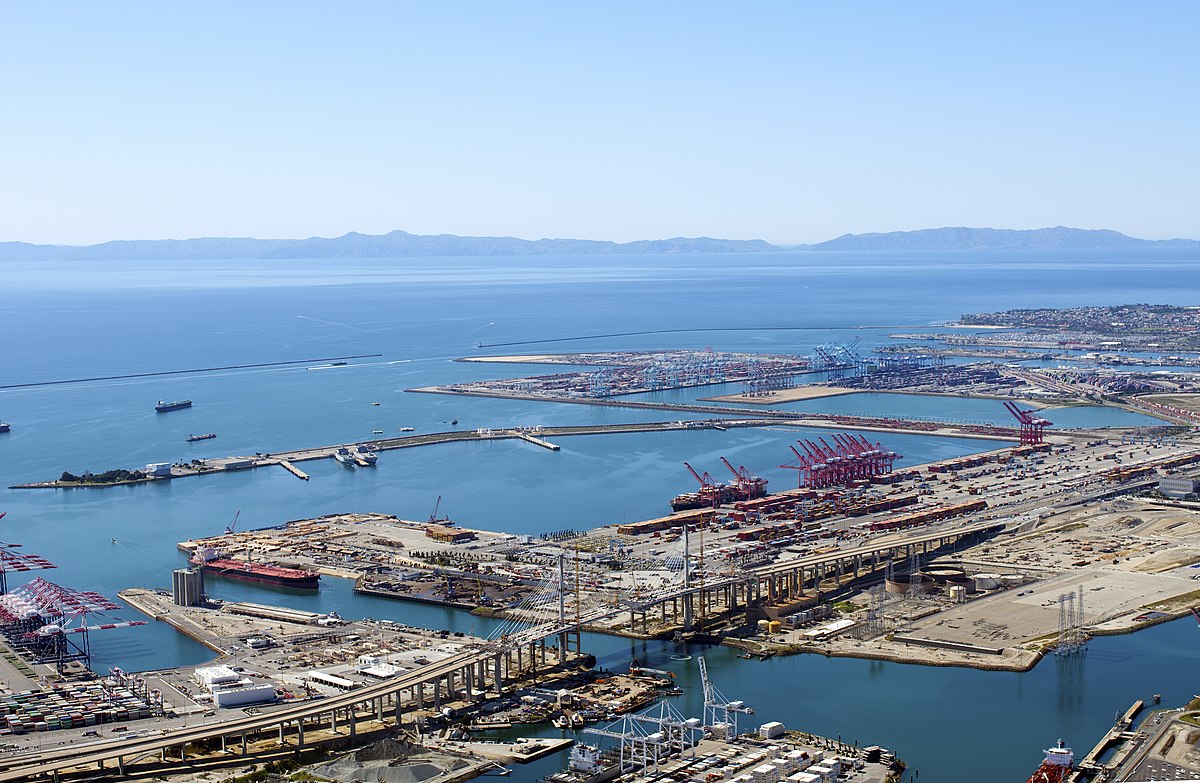
Known as America’s Port, the Port of Los Angeles is the largest port in the US by container volume and cargo value, and has held the number-one spot among American ports for over two decades. Situated in San Pedro Bay, it handled roughly 10.3 million TEUs in 2024 — the first time the port crossed the 10-million milestone — and processes close to 20% of all containerised imports entering the country.
Spread across some 7,500 acres of land and water, the port operates around 25 cargo terminals handling automobiles, electronics, apparel and dry and liquid bulk. Its trade is heavily oriented toward Asia, with China, Japan, Vietnam and South Korea among its leading partners. Beyond the numbers, the Port of Los Angeles is one of Southern California’s biggest economic engines, supporting millions of jobs across the country and investing billions in cleaner, more automated operations.

2. Port of Long Beach
Sitting right beside the Port of Los Angeles, the Port of Long Beach is the second-largest port in the US, handling about 9.65 million TEUs in 2024. Together, the two ports form the San Pedro Bay port complex — the single largest container gateway in the Western Hemisphere, moving close to 20 million TEUs a year between them.
Long Beach is known for its scale and its sustainability leadership; it has long marketed itself as one of the “greenest” ports in the world, pioneering shore power, zero-emission equipment and its Green Port Policy. Across roughly six container terminals and 175-plus shipping-line connections, it specialises in containerised consumer goods and petroleum products, and generates over $100 billion in trade each year while supporting hundreds of thousands of California jobs.
3. Port of New York and New Jersey
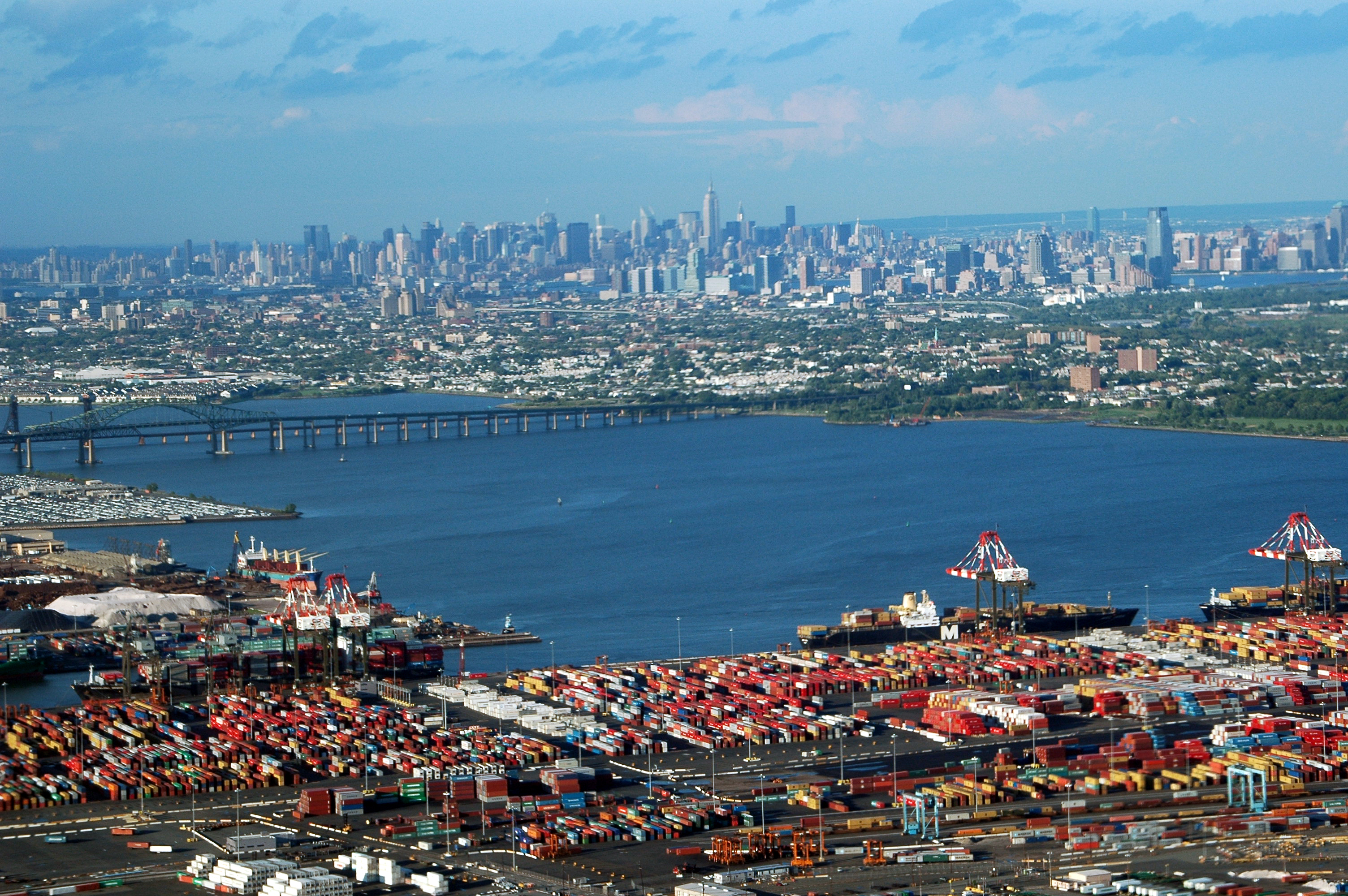
The Port of New York and New Jersey is the largest port on the US East Coast and the third-largest in the nation, moving about 8.7 million TEUs in 2024. Spanning facilities across New York Harbour and Newark Bay, this sprawling complex is the primary maritime gateway for the densely populated Northeast — one of the biggest consumer markets on earth.
It’s a genuinely diversified port, handling containers, automobiles, petroleum products, furniture, machinery and bulk cargo. During the West Coast congestion of 2021–22 it briefly became the nation’s second-busiest port, and it continues to invest heavily in deeper channels and raised bridge clearances to accommodate the largest container ships afloat. Its main trading partners include China, India, Germany, Italy and the Netherlands.
4. Port of Savannah
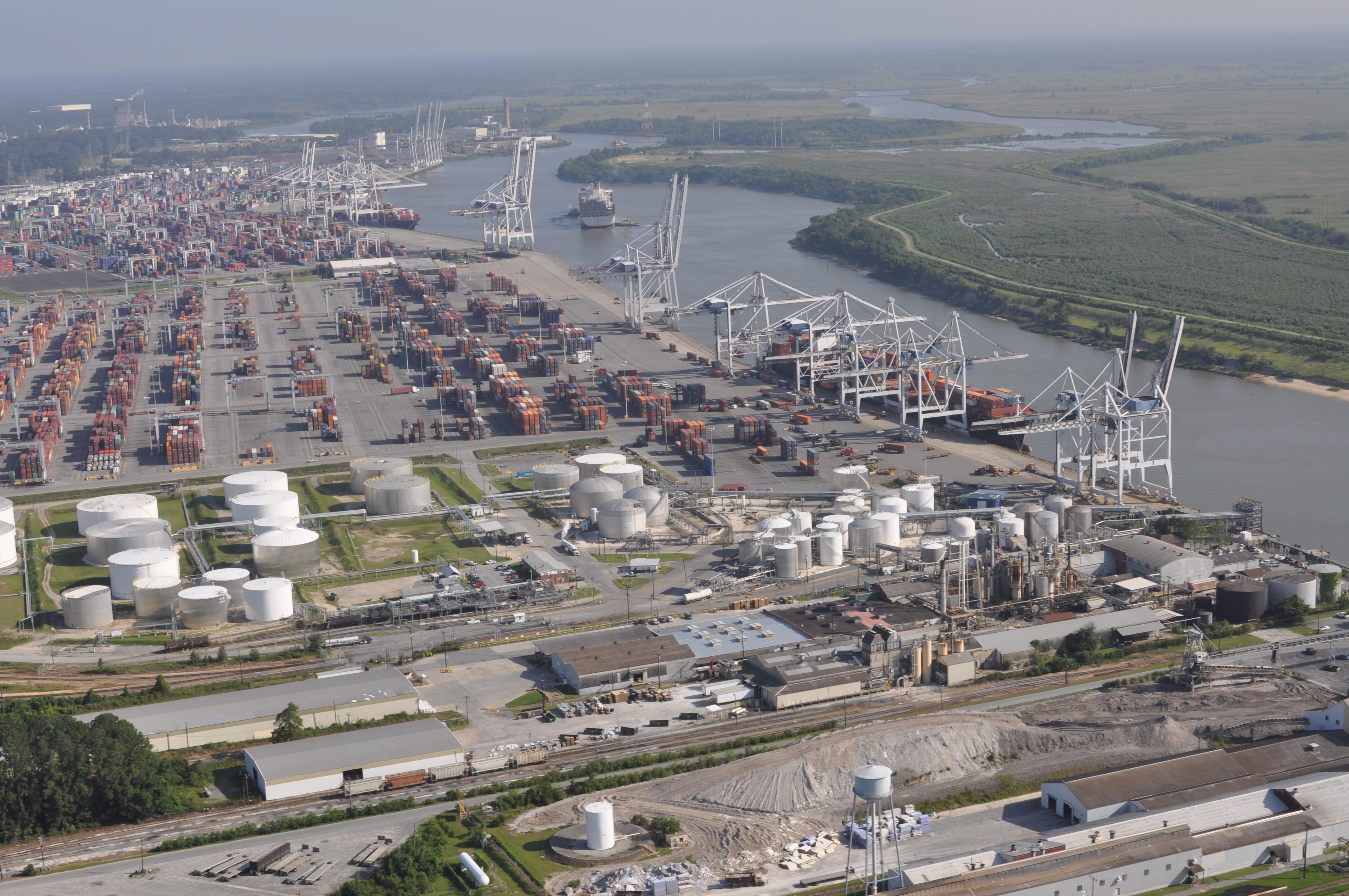
Located in Georgia, the Port of Savannah is one of the fastest-growing ports in the nation and the fourth-largest by container volume, handling roughly 5.55 million TEUs in 2024. Its Garden City Terminal is the single largest container terminal in North America, and its position gives it deep reach into the fast-growing markets of the American Southeast.
Savannah’s success is a story of infrastructure investment — deepened harbours, expanded rail connections and added crane capacity have let it absorb cargo that once flowed only through the coasts’ traditional giants. For importers looking to diversify away from congested West Coast routes, Savannah has become one of the most important major ports in America.
5. Port of Houston
As the busiest container port on the Gulf Coast, Port Houston handled about 4.1 million TEUs in 2024 — a record year — and ranks fifth nationally. But containers only tell part of the story: Houston sits at the heart of the largest petrochemical complex in the United States, so petroleum and its derivatives dominate its overall cargo, and by total tonnage Houston is one of the biggest ports in America.
The port stretches along the 50-mile Houston Ship Channel and includes the Bayport and Barbours Cut container terminals, among the most technologically advanced in the country. Alongside energy products, it moves steel, plastics, resins, grain and machinery, trading heavily with Europe, Latin America, Africa and the Middle East. Ongoing widening and deepening of the ship channel is designed to let two-way traffic of the largest vessels pass safely.

6. Port of Seattle
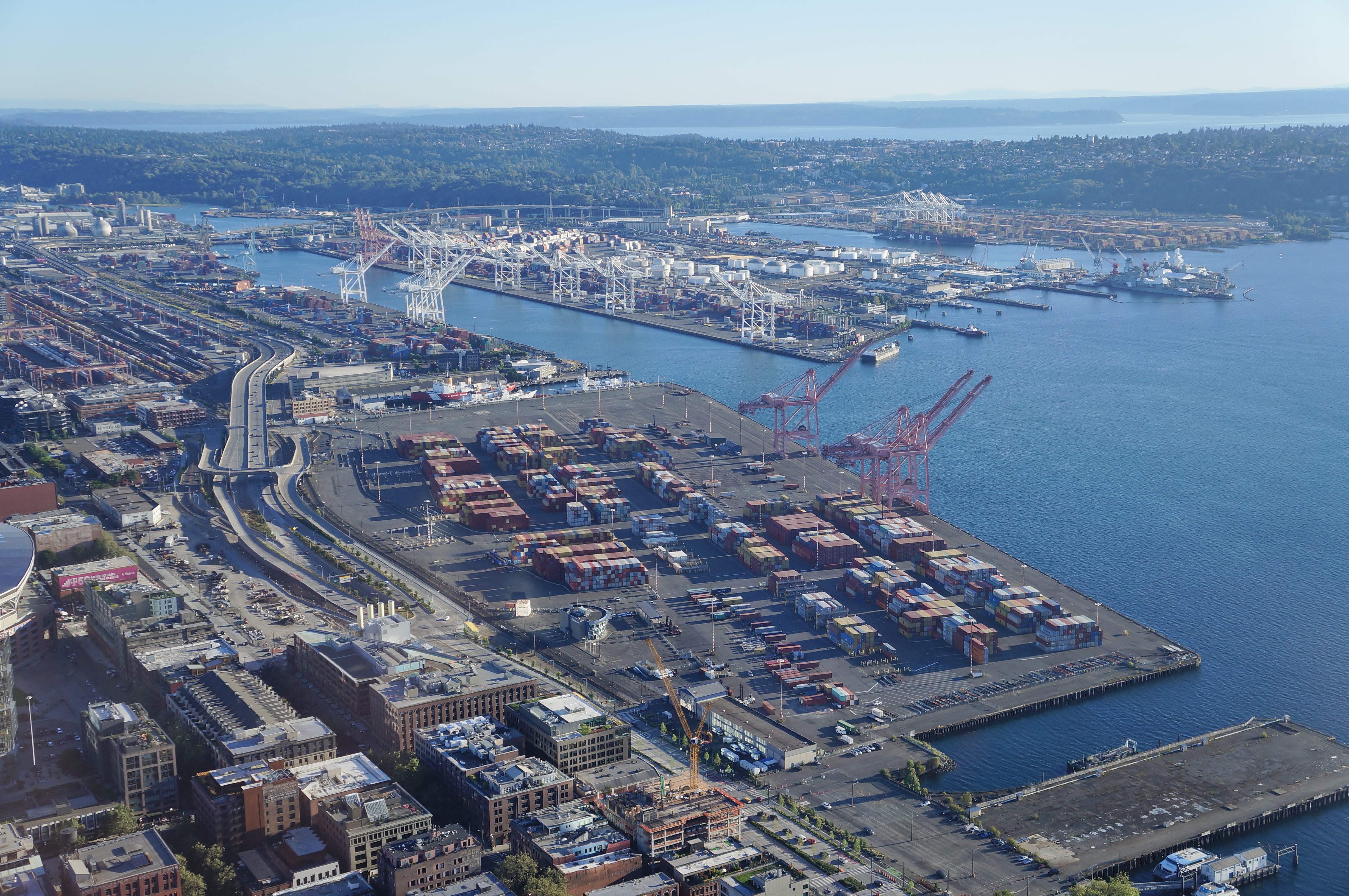
The Port of Seattle, in the Pacific Northwest, is a key gateway for trade with Asia, handling containers, automobiles and bulk cargo. Since 2015, Seattle has operated jointly with the Port of Tacoma under the Northwest Seaport Alliance — together they form the fourth-largest container gateway on the West Coast and one of the largest in the country, with combined 2024 volumes of about 3.34 million TEUs.
Seattle’s terminals are especially important for refrigerated exports and trans-Pacific trade, and the surrounding region’s role as a technology and aerospace hub keeps a steady flow of high-value cargo moving through its berths.
7. Port of Charleston
Located in South Carolina, the Port of Charleston is renowned for its deep water and efficient operations, handling roughly 2.5 million TEUs in 2024. It has one of the deepest harbours on the US East Coast — a decisive advantage as shipping lines deploy ever-larger vessels — and specialises in containerised cargo and automotive shipments.
Charleston benefits from the same Southeastern boom that has powered Savannah’s rise: growing population, expanding manufacturing (including major automakers) and heavy investment in terminals and inland connectivity. It’s a compact but fast, modern port that consistently ranks among America’s most productive.

8. Port of Oakland
Serving Northern California, the Port of Oakland handled about 2.26 million TEUs in 2024. Spread across roughly 1,300 acres on the eastern side of San Francisco Bay, it’s a crucial gateway for trade with Asia and, importantly, a major export port — a rarity in a country that imports far more than it ships out.
Oakland is a leading exporter of California’s agricultural bounty: almonds, wine, fruit, dairy and other refrigerated goods pass through its terminals on their way to Asian markets. The port is investing in bigger-vessel berths, improved rail and emissions-reduction programmes to keep its role in the trans-Pacific trade strong.

9. Port of Virginia (Hampton Roads)
The Port of Virginia, centred on the Hampton Roads harbour, is one of the largest natural deep-water harbours in the world and a critical East Coast gateway, moving around 3.5 million TEUs in 2024. Its naturally deep channels — among the deepest on the East Coast — allow it to receive the ultra-large container vessels that many rival ports still can’t handle fully loaded.
Covering close to 1,900 acres, the port is a major mover of containerised goods, coal and forest products, and it has invested in highly automated terminals and expanded rail to speed cargo inland. Its combination of deep water, room to grow and strong rail links has made it one of the most competitive major ports on the Atlantic seaboard.

10. Port of Tacoma
Partnering with Seattle in the Northwest Seaport Alliance, the Port of Tacoma handles containers, automobiles, heavy machinery and bulk cargo, and contributes significantly to the region’s economy. Tacoma’s deep harbour and generous terminal space make it a natural home for oversized and project cargo, as well as a major link in trade with Alaska and Asia.
Ranking the two Northwest ports individually can be misleading — because they market and plan capacity together, they’re best understood as a single major gateway. Combined, they rank among the top container hubs in the United States and anchor the Pacific Northwest’s connection to global trade.

11.Port of New Orleans
Situated along the Mississippi River, the Port of New Orleans is one of the country’s most important ports by a measure other than containers. While its container throughput is modest compared with the coastal giants, it is a leading hub for bulk and breakbulk cargo — steel, rubber, coffee, grain and project cargo — and a linchpin of the Mississippi River trade system that drains America’s agricultural heartland to the sea.
New Orleans is also unusually connected: it’s served by six Class-I railroads and sits at the head of the inland barge network, making it a true intermodal crossroads. Add its role in cruise traffic and its storied maritime history, and it earns its place on any list of America’s biggest and most significant ports.

How are the largest US ports ranked?
Because different cargoes are measured in different ways, there’s no single “biggest port.” The three most common yardsticks are:
- Container volume (TEUs): the standard for ranking the busiest container ports — this is where Los Angeles, Long Beach and New York & New Jersey lead.
- Total cargo tonnage: counts all cargo by weight, including bulk liquids and dry bulk — here Gulf energy and grain ports such as Houston and South Louisiana top the list.
- Cargo value: the dollar worth of goods, which tracks closely with high-value container trade.
For most readers asking “what is the largest port in the US,” the answer is the Port of Los Angeles by container volume. But a shipper moving crude oil or grain would rightly point to the Gulf.
Conclusion
These 11 ports represent the backbone of America’s maritime infrastructure, facilitating trade and commerce on a global scale. Whether it’s the record-breaking container terminals of Los Angeles and Long Beach, the fast-rising Southeastern hubs of Savannah and Charleston, the deep-water advantage of Virginia, or the historic river trade of New Orleans, each of the biggest ports in the US offers a window into how global commerce actually works. Understanding them is essential for anyone involved in logistics, shipping or international business — and a reminder of just how much of daily life passes quietly across a dock.
Frequently asked questions
What is the largest port in the US?
By container volume, the Port of Los Angeles is the largest port in the US, handling around 10.3 million TEUs in 2024 — the first American port to cross the 10-million mark. Together with neighbouring Long Beach, it forms the biggest container gateway in the Western Hemisphere.
What are the biggest ports in the US?
The largest ports in America by 2024 container volume are Los Angeles, Long Beach, New York & New Jersey, Savannah, Houston, Virginia, the Seattle–Tacoma Northwest Seaport Alliance, Charleston, Oakland and New Orleans.
What is the biggest port on the US East Coast?
The Port of New York and New Jersey is the largest port on the East Coast and the third-largest in the nation.
What is the busiest port in America?
By container traffic, the Port of Los Angeles is the busiest port in America. By total cargo tonnage, however, Gulf Coast ports such as Houston and South Louisiana handle the most.
How are US ports ranked?
Ports are usually ranked by container volume (TEUs), total cargo tonnage, or cargo value. Container-volume rankings are the most widely cited when people talk about the “biggest” or “largest” ports.
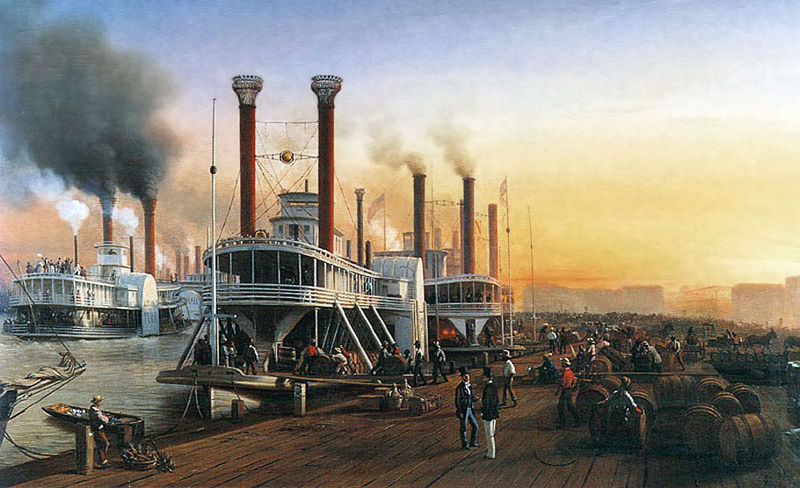
Feature Image: New-Orleans-Hippolyte Sebron – Bateaux A Vapeur Géants 1853 |Courtesy:wikipedia